Start with bits, qubits and simple visual activities. Build toward circuits and quantum concepts at your own pace.
Skills you will build: Describe bits, qubits and measurement in plain language, then build toward simple circuit experiments.
Before you start: Basic computer skills and curiosity. No coding or advanced math is needed for the first four introductory lessons. Later lessons introduce probability, Python and linear algebra step by step.
Suggested study time: 72 hours · self-paced
Equipment: For the first lessons: a phone or computer, plus paper and a pen. A computer and visual simulator are useful for later circuit activities. No coding or advanced math is needed to start.
Your first project: Begin with a paper comparison of a bit and a qubit, count sample results, and draw a simple X-gate circuit. Guided H and Bell circuits come later.
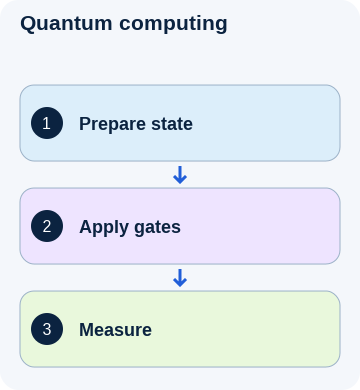
An ideal circuit transforms amplitudes; measurement produces classical outcomes with specified probabilities.
Connect it to this lesson: Quantum Computing fundamentals. Identify where the idea fits in the map, then explain it using the lesson’s example. This is a program-level concept map; the written lesson provides the specific detail.
Mini challenge · predict before revealing
Must 100 shots of an ideal equal-probability preparation split exactly 50/50?
Explain the answer
Finite samples fluctuate. Equal probabilities do not force equal finite counts.
Practice only. This does not change course progress, certificates or reward eligibility. Explain the answer without looking before moving on.
Course Outline
Explore all 20 lessons, with teaching notes, examples, practical exercises and knowledge checks. The first three lessons are free to preview without an account.
Study time includes extended reading and practice. Free sample previews take about 15–25 minutes each. Create a free account to continue with the full course.
Sample topics and lessons
Start here: bits and qubits
Full lesson study allowance: 1 hr 55 min · Free preview: about 15–25 minutes
An ordinary computer stores information using bits: each bit is 0 or 1. A quantum computer uses qubits. Measuring a qubit in our introductory examples gives one result, 0 or 1. Before measurement, a qubit can be in a quantum state called superposition. This does not mean you can read two answers at once. We will explore the idea visually before using equations.
Practice activity: Draw the two pictures. Write the two possible measurement results for one qubit.
Full lesson study allowance: 1 hr 55 min · Free preview: about 15–25 minutes
Probability describes how likely an outcome is. Start with counting, not formulas. If an activity has equal chances of 0 and 1, repeated trials often give roughly equal counts. Small samples need not split evenly. A coin is a counting illustration, not a complete model of a qubit.
Practice activity: Count the zeros and ones in 0, 1, 1, 0, 1, 0, 0, 1, 1, 1. Must every ten trials split five and five?
Full lesson study allowance: 1 hr 55 min · Free preview: about 15–25 minutes
A circuit diagram shows operations in order. A gate is an operation on a qubit. First try the X gate, which changes 0 to 1 and 1 to 0. Draw a starting 0, an X box and a measurement box. Later we introduce H, a gate that prepares a state with equal chances of 0 and 1 when starting from 0.
Practice activity: Draw a starting 0 followed by two X boxes and a measurement box. Predict the result. You can do this on paper.
Watch for: Choose a topic you want to revise. Pause and explain the idea in your own words, then try the quiz without the video.
For a long course, choose the relevant chapter; you do not need to watch the entire video before continuing. This is a supporting program video and may cover only selected topics; it is not a separate recording of every lesson. Videos are optional; use the written lesson and exercises too.
If playback is unavailable, use the source link. Look for captions or a transcript on the provider’s page.
Try a sample practice quiz
Answer all 3 questions, then check your score below. This is a practice check, not the full course or an official certification exam.
Build a portfolio project
Compare X, H, H–H and a Bell circuit: draw each circuit, predict outcomes, record simulated or paper results and explain limitations.
Save progress, practice with quizzes and earn an M.E.T. foundation completion certificate. External professional certifications have separate requirements.